Todd Hauer, a reader of Autoweek, spotted the test mule:
“I happened to catch this somewhat disguised X5 (notice the BMW logos are covered on hood, tail and wheels but X5 emblem isn’t) at a filling station in Lone Tree, Colo., just south of Denver. Talked briefly with the driver, who was German. He said he had driven cross country from South Carolina for altitude testing here. It is the the turbo-diesel model; he acknowledged the turbo diesel was a good choice for the mountains and that the driving characteristics of the new X5 were a bit different than the current model.”
At launch time this summer, BMW will offer to U.S. customers the TwinPower Turbo inline-six X5 sDrive35i and X5 xDrive35i as well as the TwinPower Turbo V8
 X5 xDrive50i.
The 2014 BMW X5 xDrive35d retains the 3.0-liter diesel engine, whose BMW TwinPower Turbo technology comprises VNT turbocharging and common rail direct injection
, now develops maximum power of 255 hp and maximum torque of 413 lb-ft which is delivered between 1,500 and 3,000 rpm.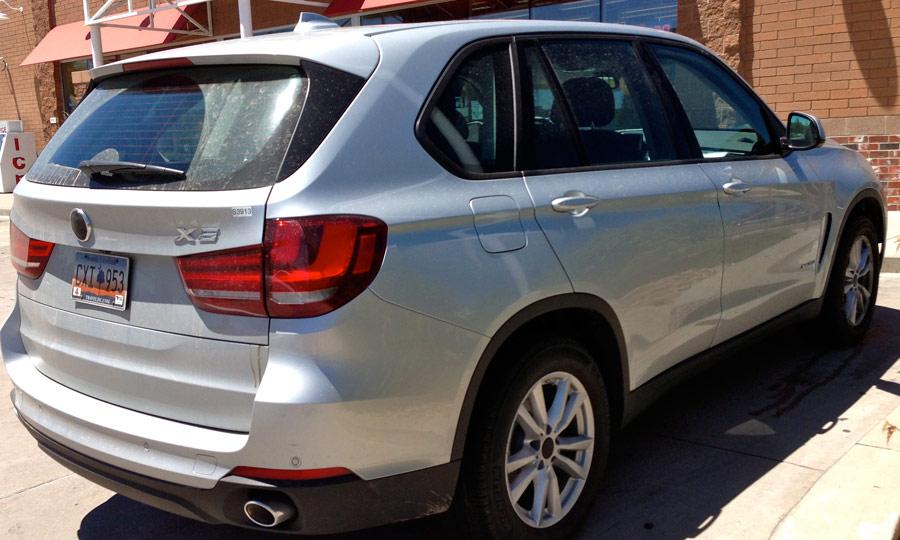
In spite of the slight reduction in output from its predecessor, the new BMW X5 xDrive35d has a 0-100 km/h (62 mph) sprint time of 6.9 seconds (preliminary), making it just as quick or quicker. With the latest technology and the addition of an 8-speed automatic transmission
,
the new model is expected to post significant improvements in
efficiency (EPA mileage estimates will be available closer to launch).
The new X5 xDrive35d uses the latest in emission reduction technology.
Lower nitrogen oxide limits are met using a close-coupled NOX adsorber
catalyst and an SCR catalyst with urea (AdBlue) injection.Just last month, Wards Auto named the BMW X5 the first premium model in the 2012 Top Selling Diesel list (with 10,276 units sold), followed with 6,688 units by Mercedes-Benz GL.


